
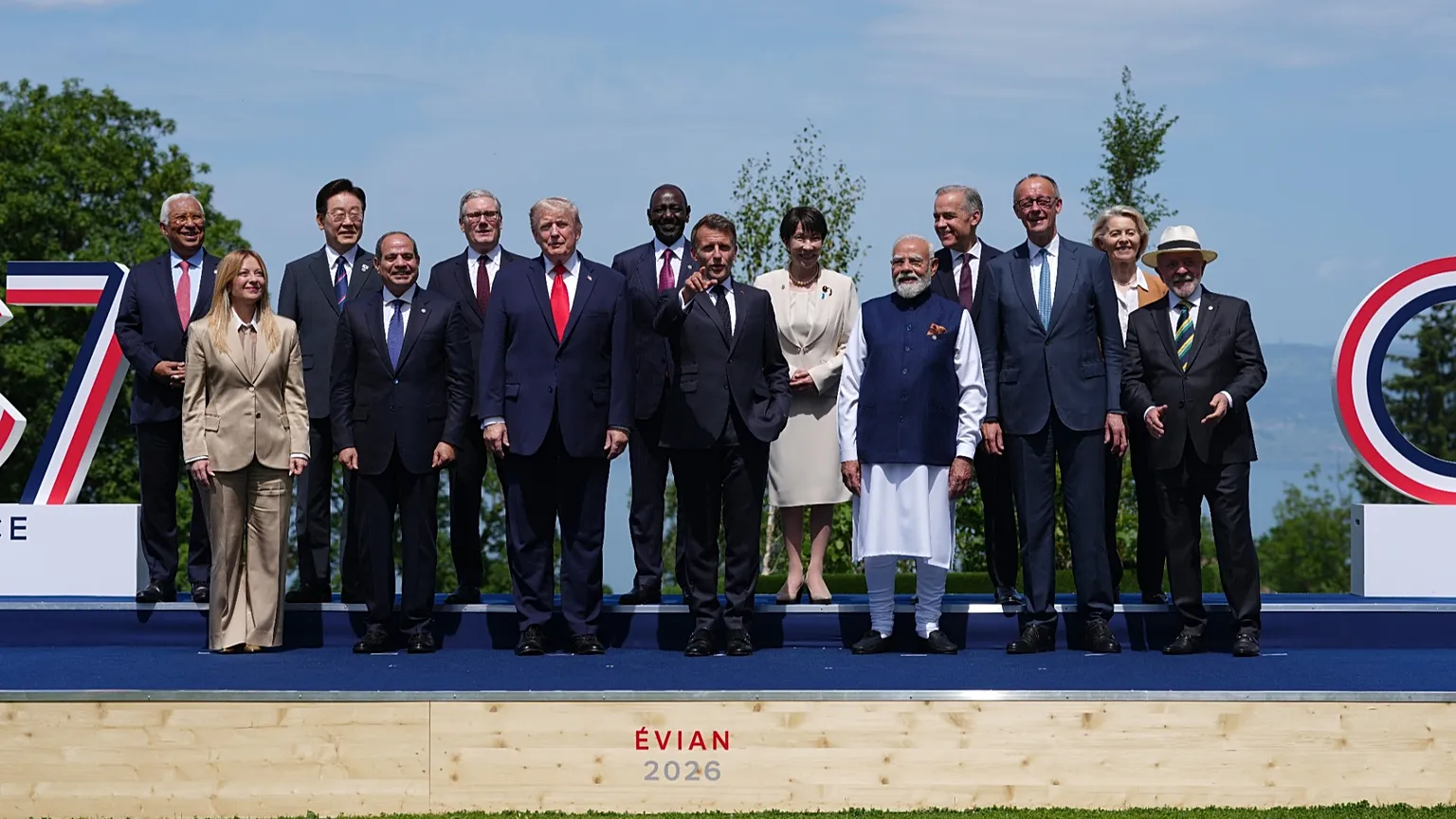
The G7 Summit held in Évian-les-Bains, France, from June 15 to 17, 2026, transcended its originally scheduled economic agenda, serving as a defining event that demonstrated how Western strategic coordination is adapting to new realities. Within the summit's official framework, discussions spanned international peace and security, sustainable global economic growth, emerging technologies, critical minerals, and supply chain security—reflecting a broader shift in the G7’s role toward the intersection of economics and security.[1] Here, "Western strategic coordination" refers not to a single monolithic institution, but rather to a complex system through which Western nations align their military-political, energy, technological, defense-industrial, sanction, and supply chain policies toward shared security goals. In this sense, the Évian G7 was more than a routine summit; it functioned as an indicator showing that Western allies must recalibrate their positions and roles within the policy environment of a second Trump administration.
Trump 2.0 and the G7’s New Adaptation
The policy approach during Trump's second term differs in certain respects from his first term. While his 2017–2020 policies presented abrupt challenges to international organizations, alliance systems, and the trade order, by 2026 this posture has become more normalized, transactional, and oriented toward leveraging existing institutions rather than dismantling them entirely. Although fundamental principles remain unchanged, the methods of implementation have shifted, with the United States more clearly utilizing multilateral platforms like the G7 as instruments to compel allies to align with its strategic direction.[2]
This shift was particularly noticeable in Évian, where some analysts noted that Trump's declaration—implying "I am the leader" during the G7—served as a clear signal of the summit's political climate, according to Reuters reporting.[3] Other G7 leaders sought pragmatic compromises with Trump across key domains such as support for Ukraine, the Iranian issue, and critical mineral supply chains, demonstrating that Western allies have adopted a tactic of "adaptation and alignment" within the Trump 2.0 policy environment.[4]
Thus, the primary objective of the Évian summit was not merely to issue a joint declaration, but to preserve G7 unity and safeguard the strategic maneuverability of other allies without entering into direct confrontation with the Trump 2.0 policy framework. According to an assessment by Chatham House, one of the central goals of the French presidency was to foster limited yet practical negotiations between Trump and other G7 members—a goal considered to have been achieved to a certain degree in Évian.[5]
Three Geopolitical Axes: Iran, Ukraine, and China
The first major challenge at the Évian G7 was the Iran–Israel conflict and energy security in the Strait of Hormuz. In its geopolitical statement, the G7 reaffirmed its commitment to preventing Iran from acquiring nuclear weapons, resolving regional and ballistic missile issues through diplomatic negotiations, and supporting defensive international maritime initiatives aimed at restoring navigation through the Strait of Hormuz.[6] This initiative, led by France and the United Kingdom, is a defensive operation focused on protecting commercial vessels, mine detection, and restoring confidence in insurance and shipping markets.[7]
It is worth clarifying the nature of the preliminary US–Iran understanding. This was a 14-item preliminary Memorandum of Understanding (MOU) covering several interconnected dimensions (reopening Hormuz, lifting US sanctions, unfreezing assets, and nuclear non-proliferation), which Trump signed at the Palace of Versailles on June 17.[8] However, it is important to emphasize that the implementation of this agreement remains unstable. Following the signing, maritime traffic briefly resumed, but slowed significantly when Iran declared the strait closed again on June 20–21, citing Israeli strikes in Lebanon as a violation of the agreement. Although US forces denied these claims and asserted that the strait remained open, the situation remains highly ambiguous and disputed. The failure of maritime traffic to return to pre-war levels underscores the fragility of this diplomatic arrangement.[9]
Regarding the Russia–Ukraine war, the Évian G7 articulated a more definitive stance. In their official communique, G7 leaders reaffirmed their steadfast support for protecting Ukraine’s freedom, sovereignty, and territorial integrity, advocating for enhanced air defense capabilities, additional missile systems, interceptors, and long-range strike capabilities.[10] According to Associated Press reports, Volodymyr Zelenskyy described commitments made at the G7 regarding Ukrainian air defense, energy resilience, and new sanctions against Russia as key outcomes.[11]
For Trump, however, Ukraine is not a matter of "unlimited support." His policy aims to support Ukraine while simultaneously raising the cost of war for Russia, narrowing Moscow's room for maneuver, and creating more favorable conditions for negotiations. The inclusion of measures in the G7 statement to increase pressure on Russia’s war economy and tighten sanctions on its oil and gas sectors aligns with this logic.[12]
Furthermore, the Hormuz crisis is interconnected with Ukraine through the energy domain. Greater stability in the Strait of Hormuz reduces shocks in global energy markets, thereby increasing the margin to exert pressure on Russian energy exports. In this sense, while Iran, Ukraine, and Russia were discussed separately at the Évian G7, they were intrinsically linked along a single energy-security nexus.
The China issue served as the primary long-term strategic focal point of the Évian meeting. Although direct naming of China was avoided, discussions on critical minerals, rare earth elements, and supply chain security were fundamentally designed to reduce Beijing's dominance. Reuters reported that the G7 agreed on measures to reduce over-reliance on single suppliers, align stockpiling policies, and launch a risk-warning and market intelligence platform in collaboration with the International Energy Agency (IEA).[13]
The G7 set a notable signal by aiming to reduce dependency on a single country to below 60% by 2030, with a further target of 50%. However, substantial implementation challenges remain. China continues to hold a dominant position in processed rare earth elements and permanent magnet production, and achieving the G7’s target requires billions of dollars in investment, processing infrastructure, and recycling capacity.[14] Furthermore, the Trump administration's proposal on critical mineral price regulations met with skepticism from G7 allies and mining industry representatives, highlighting that a fully unified position has yet to materialize in this domain.[15]
Counter-Perspectives
However, it is also possible to view the Évian summit through a lens other than mere "adaptation". 1. Temporary Crisis Management: Évian may have been less about structural recalibration and more about the temporary management of concurrent crises. G7 leaders may have focused on extinguishing immediate fires rather than establishing a fundamentally new architecture. 2. Containment of Volatility: Rather than adapting to Trump’s policies, the G7 may have been attempting to constrain his volatility and stabilize his actions within a multilateral framework. 3. Lack of Alternatives: Allies may not be accepting US leadership per se, but rather temporarily accommodating it simply because no viable alternative currently exists.[16]
In any case, Évian represents a dual phenomenon containing elements of both short-term crisis management and long-term strategic realignment; only subsequent dynamics will determine which aspect prevails.
Conclusion
The Évian G7 summit can be viewed as a process wherein Western strategic coordination is recalibrating itself under the conditions of Trump 2.0. Looking at the agenda as a whole, the simultaneous transformation of energy, sanctions, defense manufacturing, supply chains, and alliance coordination into security issues indicates that a broader structural shift is underway.[17]
In conclusion, the Évian G7 demonstrated not that Western strategic coordination has completely transformed, but rather that the necessity to recalibrate it to new realities has intensified. However, considering the alternative perspectives outlined above and the fragility of the Iranian agreement, this event is highly likely to represent not a "triumph," but rather a "managed adaptation that postponed fragmentation." While Trump 2.0 policy has not dismantled the Western alliance, it is reshaping it into a more hierarchical, transactional, and interest-driven framework.
References:
[1]Council of the EU, “G7 Leaders’ Joint Statements — Évian, France, 16–17 June 2026,” 17 June 2026 (https://www.consilium.europa.eu/en/press/press-releases/2026/06/17/g7-leaders-joint-statements-evian-france-16-17-june-2026/); Élysée, “2026 G7 Summit of Évian” (https://www.elysee.fr/en/G7evian).
[2]Creon Butler, “Macron’s Evian Summit Shows the Limits Trump Places on the G7,” Chatham House, 19 June 2026 (https://www.chathamhouse.org/2026/06/macrons-evian-summit-shows-limits-trump-places-g7).
[3]Julia Payne, “‘I’m the Boss,’ Says Trump to G7 Summit,” Reuters, 18 June 2026. (Агуулгыг NBC News, AFP баталсан.)
[4]Butler, “Macron’s Evian Summit Shows the Limits Trump Places on the G7.”
[5]Élysée, “G7 Leaders’ Statement on Geopolitical Issues,” 17 June 2026 (https://www.elysee.fr/en/G7evian/2026/06/17/g7-leaders-statement-on-geopolitical-issues).
[6]Élysée, “G7 Leaders’ Statement on Geopolitical Issues,” 17 June 2026 (https://www.elysee.fr/en/G7evian/2026/06/17/g7-leaders-statement-on-geopolitical-issues).
[7]John Irish & Parisa Hafezi, “France, Britain Push Hormuz Mission as Truce Nears, but Iran’s Stance Key,” Reuters, 15 June 2026. Мон Эх сурвалж: “UK, France to host meeting of defense ministers on Hormuz,” The Times of Israel.
[8]NBC News, “Trump and Iran sign agreement on ending the war,” 17 June 2026 (14-зүйлийн MOU-ийн эх бичвэр); бодит зуучлагчид (Катар, Пакистан): RFE/RL, 18 June 2026.
[9]“Shipping stalls in Strait of Hormuz after Iran declares key waterway closed again,” CNBC (Windward, Lloyd’s List өгөгдөл), 22 June 2026 (https://www.cnbc.com/2026/06/22/strait-of-hormuz-iran-us-shipping-oil.html).
[10]Élysée, “G7 Leaders’ Statement on Geopolitical Issues,” 17 June 2026.
[11] Associated Press, “Zelenskyy Says G7 Leaders Pledge More Vital Help for Ukraine against Russia,” 17 June 2026.
[12] Élysée, “G7 Leaders’ Statement on Geopolitical Issues,” 17 June 2026.
[13] Julia Payne, “G7 Sets Up Critical Minerals Alliance, Platform to Cut Reliance on China,” Reuters, 17 June 2026.
[14] Atlantic Council GeoEconomics Center, “Seven charts that will define France’s G7 summit,” 12 June 2026 (https://www.atlanticcouncil.org/dispatches/seven-charts-that-will-define-frances-g7-summit/).
[15] Julia Payne & Ernest Scheyder, “Trump’s Critical Minerals Pricing Plan Faces Skeptical G7, Divided Industry,” Reuters, 15 June 2026.
[16]Эсрэг тайлбаруудын онолын суурь: Creon Butler, “Macron’s Evian Summit Shows the Limits Trump Places on the G7,” Chatham House, 19 June 2026; мөн John Kirton, “Promising but Precarious Prospects for the G7’s Evian Summit,” G7 Research Group, University of Toronto, 31 March 2026.
[17]Council of the EU, “G7 Leaders’ Joint Statements — Évian, France, 16–17 June 2026.”